Dead and Going to Die
We photograph things in order to drive them out of our minds.
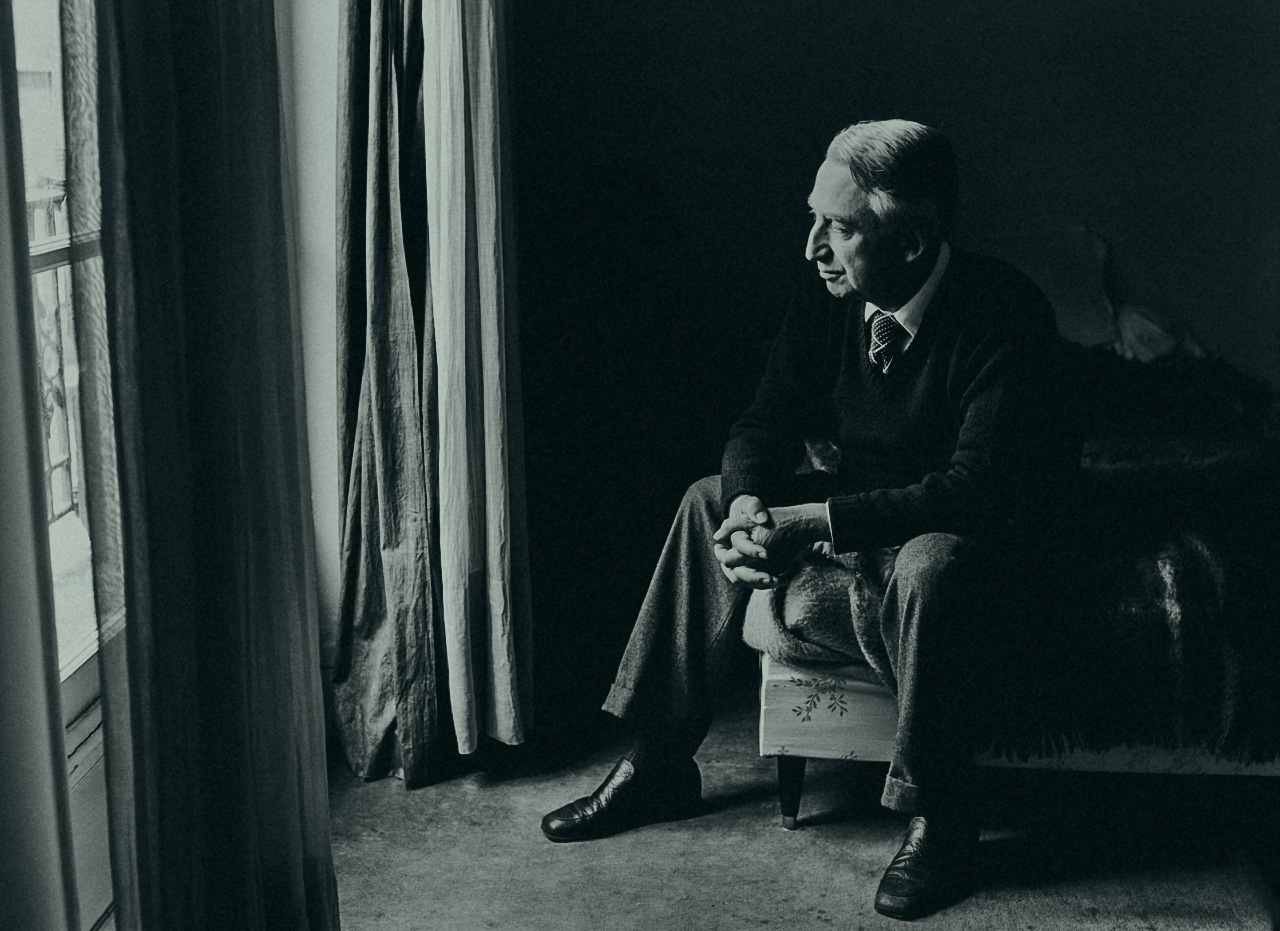
On Monday, 25 February 1980, Roland Barthes attended a lunch hosted by François Mitterrand. Perhaps it was exasperation, or simply boredom (he was often bored), that made him decide, once lunch was over, to clear his head and walk home alone to his apartment on Rue Servandoni. At about 3:45 p.m., Barthes paused before crossing the street at 44 Rue des Écoles. He looked both ways but failed to notice an approaching laundry van, which knocked him down. Unconscious and bleeding from the nose, without an identity card or any other form of identification, he was taken by ambulance to the Salpêtrière hospital. No one knew who he was, which is why the media did not learn of the accident until much later. He died the following month.
Yesterday I reread Camera Lucida (La Chambre claire, 1980) by Roland Barthes. A book of mourning, a book about photography. What Barthes wrote was neither a work of strict theory nor an avant-garde polemic, still less a history or sociology of photography. Instead, it was a deeply personal, even sentimental collection of notes, perhaps something to be expanded upon, but left in its raw form and immortalised as such. And it can change someone’s life. Barthes wrote the book to discover for himself whether photography had an essence.
What interests me most is Barthes’s way of looking at photographs through studium and punctum. Studium refers to the cultural, linguistic and political interpretation of a photograph; punctum is the detail that wounds us, touches us personally and establishes a direct relationship with the object or person in a photograph. Written after his mother’s death, Camera Lucida is as much a reflection on death as it is on photography. Death and photography mingle in a way they do in no other art.
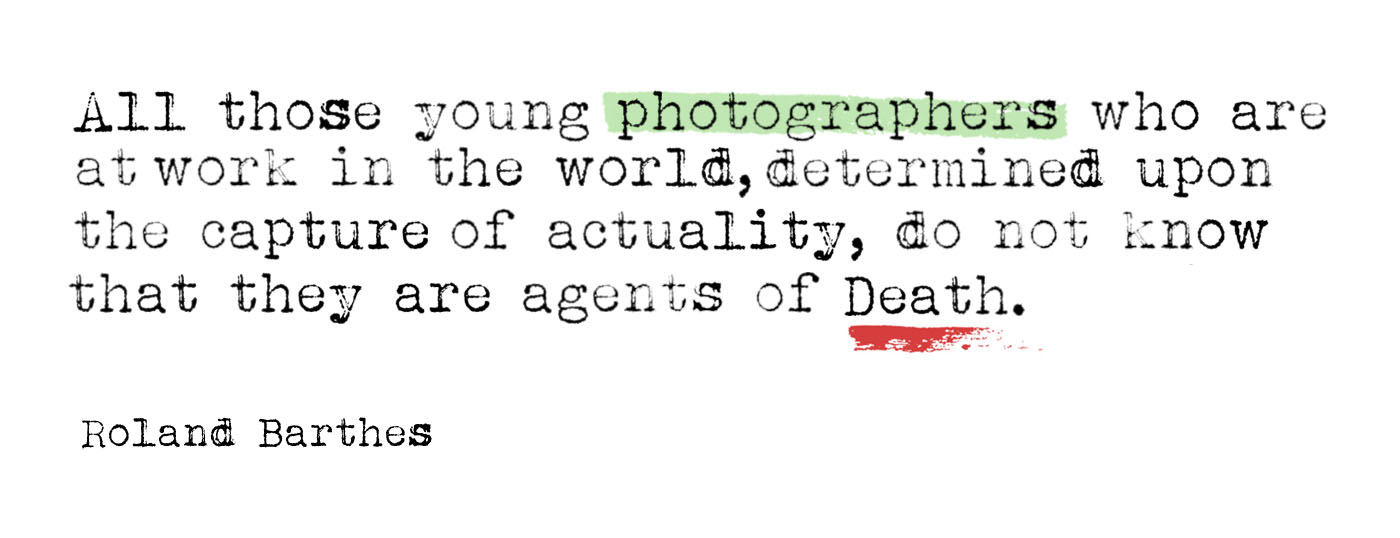
“The Photograph does not call up the past (nothing Proustian in a photograph),” writes Barthes. “The effect it produces upon me is not to restore what has been abolished (by time, by distance) but to attest that what I see has indeed existed.”
Instead of relying on theory alone, Barthes searched for a photograph of his mother after she died. He went through photographs from all stages of her life, unable to find her in any of them, until he came upon one taken in 1898, when she was five years old.
“There I was, alone in the apartment where she had died, looking at these pictures of my mother, one by one, under the lamp, gradually moving back in time with her, looking for the truth of the face I had loved. And I found it. The photograph was very old. The corners were blunted from having been pasted into an album, the sepia print had faded, and the picture just managed to show two children standing together at the end of a little wooden bridge in a glassed in conservatory, what was called a Winter Garden in those days. My mother was five at the time (1898), her brother seven. He was leaning against the bridge railing, along which he had extended one arm; she, shorter than he, was standing a little back, facing the camera; you could tell that the photographer had said, ‘Step forward a little so we can see you’; she was holding one finger in the other hand, as children often do, in an awkward gesture. The brother and sister, united, as I knew, by the discord of their parents, who were soon to divorce, had posed side by side, alone, under the palms of the Winter Garden (it was the house where my mother was born, in Chennevieres-sur-Marne).I studied the little girl and at last rediscovered my mother. The distinctness of her face, the naive attitude of her hands, the place she had docilely taken without either showing or hiding herself, and finally her expression, which distinguished her, like Good from Evil, from the hysterical little girl, from the simpering doll who plays at being a grownup-all this constituted the figure of a sovereign innocence (if you will take this word according to its etymology, which is: ‘I do no harm’), all this had transformed the photographic pose into that untenable paradox which she had nonetheless maintained all her life: the assertion of a gentleness. In this little girl’s image I saw the kindness which had formed her being immediately and forever, without her having inherited it from anyone; how could this kindness have proceeded from the imperfect parents who had loved her so badly-in short: from a family? Her kindness was specifically out-of-play, it belonged to no system, or at least it was located at the limits of a morality (evangelical, for instance); I could not define it better than by this feature (among others): that during the whole of our life together, she never made a single ‘observation.’ This extreme and particular circumstance, so abstract in relation to an image, was nonetheless present in the face revealed in the photograph I had just discovered. ‘Not a just image, just an image,’ Godard says. But my grief wanted a just image, an image which would be both justice and accuracy-justesse: just an image, but a just image. Such, for me, was the Winter Garden Photograph.”
Therein lies its haunting, unsettling quality: photography attests to our mortality.
“The photograph possesses an evidential force, and that its testimony bears not on the object, but on time. From a phenomenological viewpoint, in the Photograph, the power of authentication exceeds the power of representation.”
Whereas film presents the flow of continuous time, a photograph interrupts our sense of continuity. For Barthes, the punctum “is Time, the lacerating emphasis of the noeme (‘that-has-been’), its pure representation.”
I am older than my mother ever got to be.
Since she died at the age of 39, or perhaps precisely because she died, I have gained a stronger sense of self and become more of the person I always wanted to be but was too afraid to try. And as I move further away from that uncertain sixteen-year-old who stoically buried his mother, I cannot help feeling that I am losing her all over again.
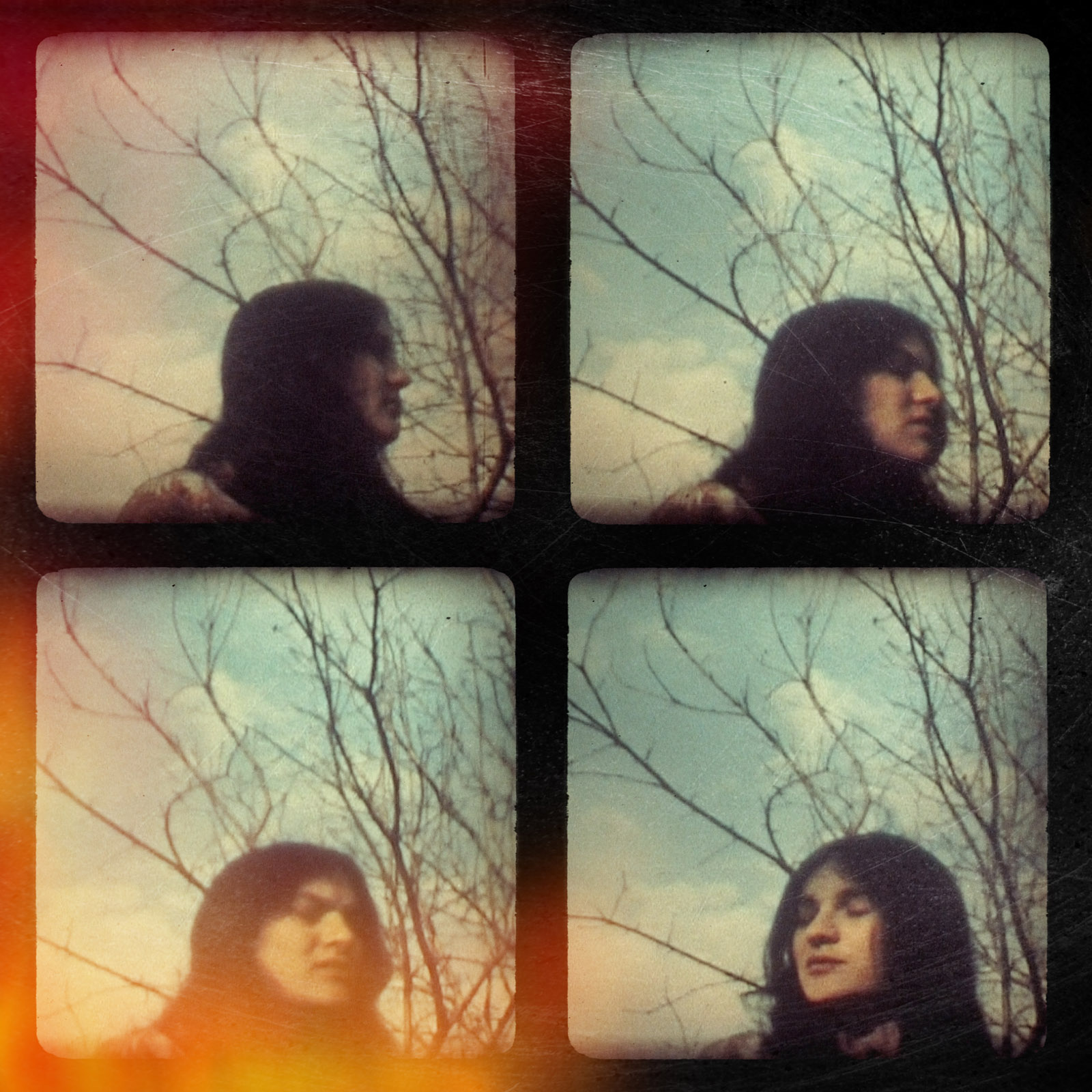
Searching for her face and looking back to the days around my conception in August 1970, I found an old 8mm film shot by my father while my mother was pregnant with me. Only four sharp frames remain. She saw something in the distance, stood quietly and thoughtfully for a moment, then suddenly frowned and turned her head with her eyes closed. On her way back to the house, she fell down the stairs and cut her knee. That memory remains as a birth scar, exactly 8mm long, on my own right knee, and as a habit of scratching it whenever I am nervous. But the memory of what we saw is lost forever.
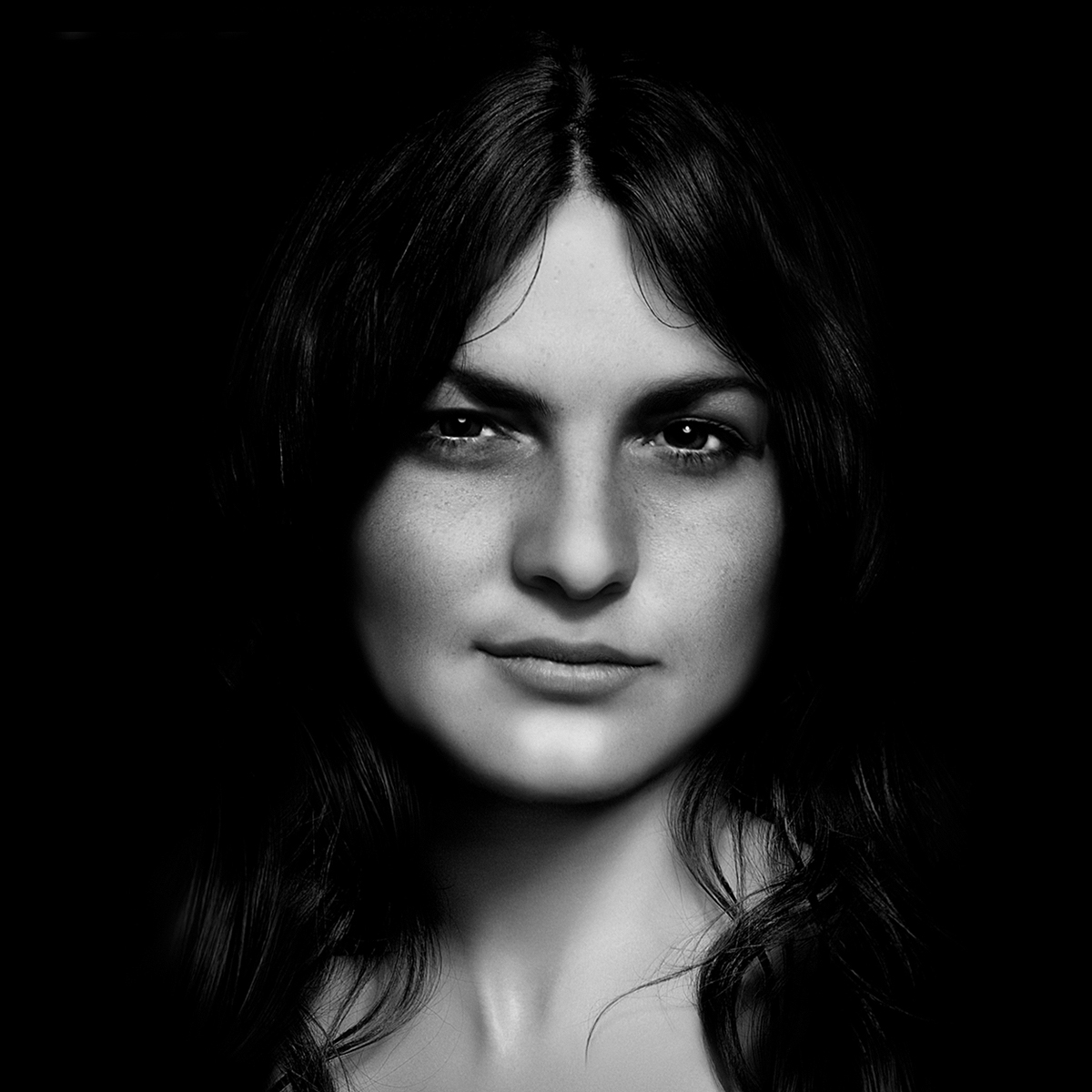
The desire to know my mother’s face again may come from realising how much I am like her. How often have I caught a glimpse of my own reflection in the mirror, surprised to find my mother’s expressions in my own?
And what could my mother say to me now, to this person she never met?
At the end of her life, shortly before the moment when I looked through her pictures and discovered the Winter Garden Photograph, my mother was weak, very weak. I lived in her weakness (it was impossible for me to participate in a world of strength, to go out in the evenings; all social life appalled me.) During her illness, I nursed her, held the bowl of tea she liked because it was easier to drink from than from a cup; she had become my little girl, uniting for me with that essential child she was in her first photograph.
Roland Barthes