Blindness
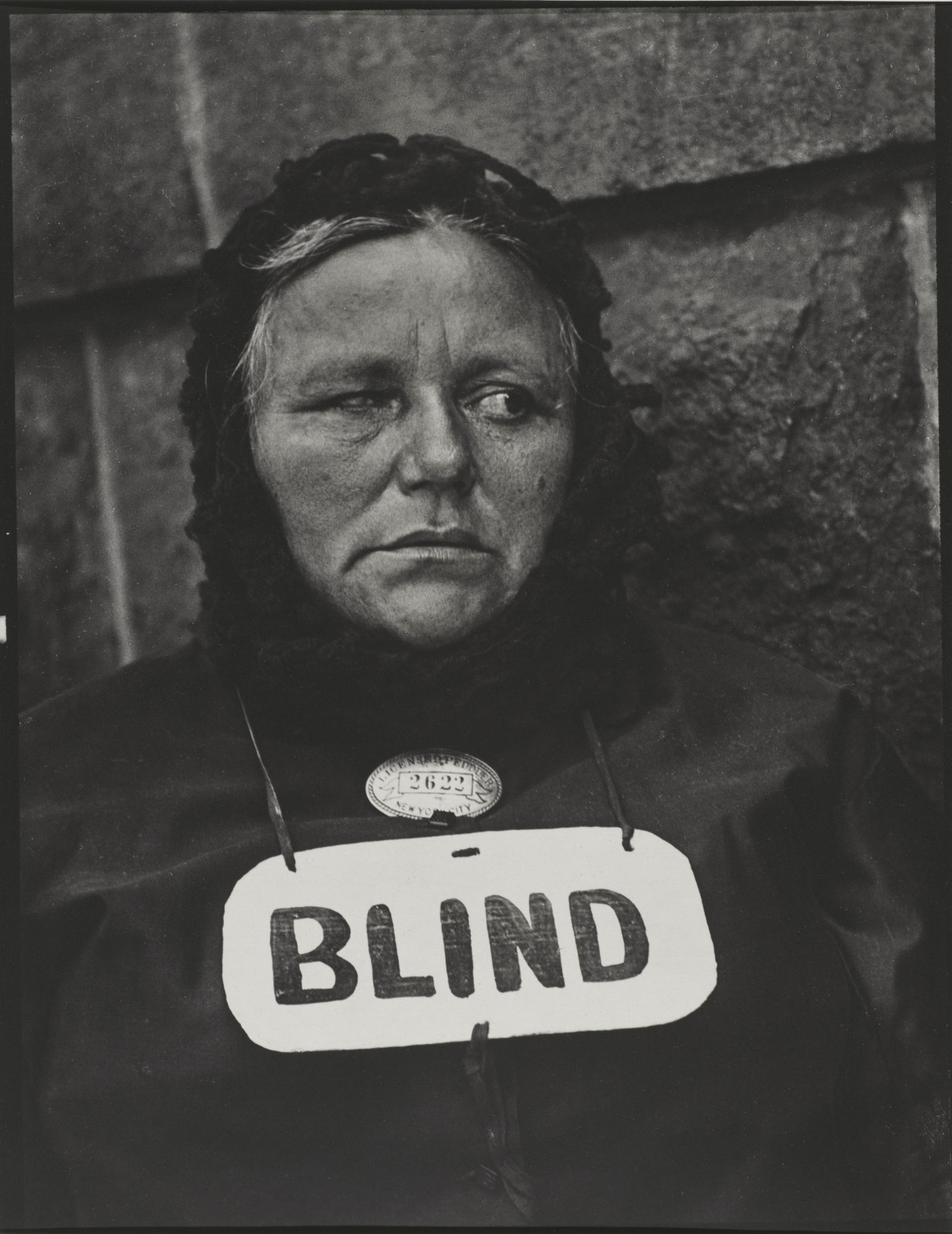
Like a mug shot, the old blind woman stands stiffly against a stone wall. The camera records her eyes looking in different directions. A large sign reading BLIND hangs from her neck. Above it, a metal badge identifies her as a licensed peddler, number 2622. Her street-worn face seems to carry everything from grit to despair.
This portrait is unsettling for several reasons. Paul Strand used a bulky 8 × 10-inch Ensign camera. At the time, he was preoccupied with how to photograph people in the street without their being aware of it.
Strand’s solution was to take the lens from his uncle’s old view camera and attach it to one side of his own camera. He then held the camera so that the false lens pointed straight ahead, while the real lens, partly concealed by his sleeve, was aimed at his subject from the side.
But the whole idea of a false lens seems unnecessary here. If the sign is to be believed, this woman is blind and presumably unable to see the photographer or his camera.
And yet there is some uncertainty about whether she has any vision in her left eye, which looks beyond the right edge of the frame. That eye seems to survey the street almost knowingly, so that the photograph slyly hints at its maker’s method: his sleight of hand and eye.
Just who is blind? The woman, the viewer, the licensing agency, or the photographer?