An Inquiry into Values | 02
And what is good, Phaedrus,
And what is not good—
Need we ask anyone to tell us these things?
These twelve photographs seem to be the only surviving images from the 1968 motorcycle journey that inspired Zen and the Art of Motorcycle Maintenance. Robert M. Pirsig sent them to Professor Henry Gurr, and I found them on Gurr’s website. Nearly all seem to have been “written into” the book. To me, they are visual references for reading it again.
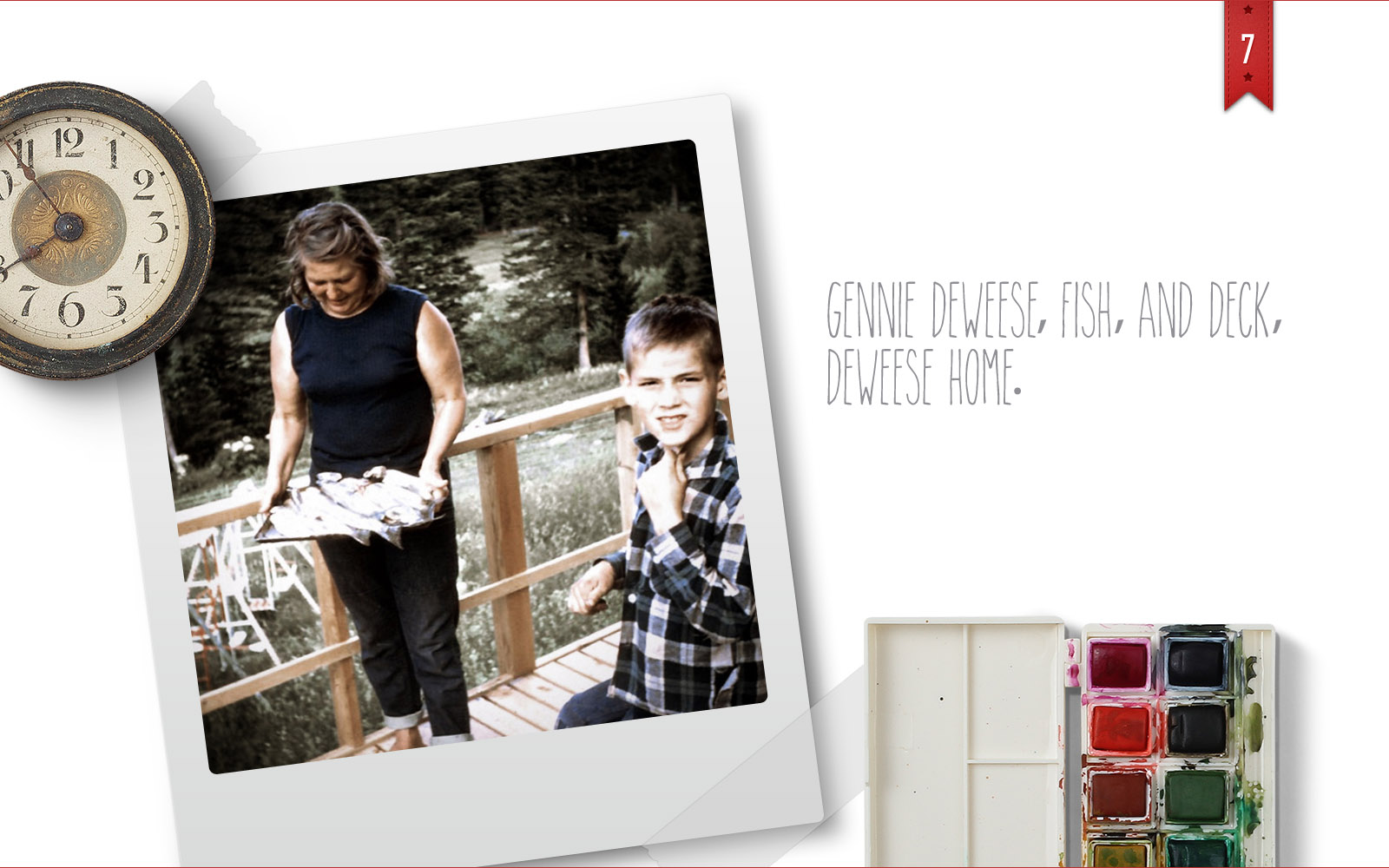
and then, from where the deck disappears around the corner of the house, suddenly comes Gennie DeWeese with a tray of beer cans. She is a painter too and, I’m suddenly aware, a quick comprehender and already there’s a shared smile over the artistic economy of grabbing a can of beer instead of her hand, …
DeWeese Home, Cottonwood Canyon, Gallatin Gateway. Gennie DeWeese and a neighbor’s boy. This is how Gennie looked in the summer of 1968. The scene is described in Chapter 14, when she mentions that neighbors have brought trout for dinner.
Some neighbors just came over with a mess of trout for dinner. I’m so pleased.
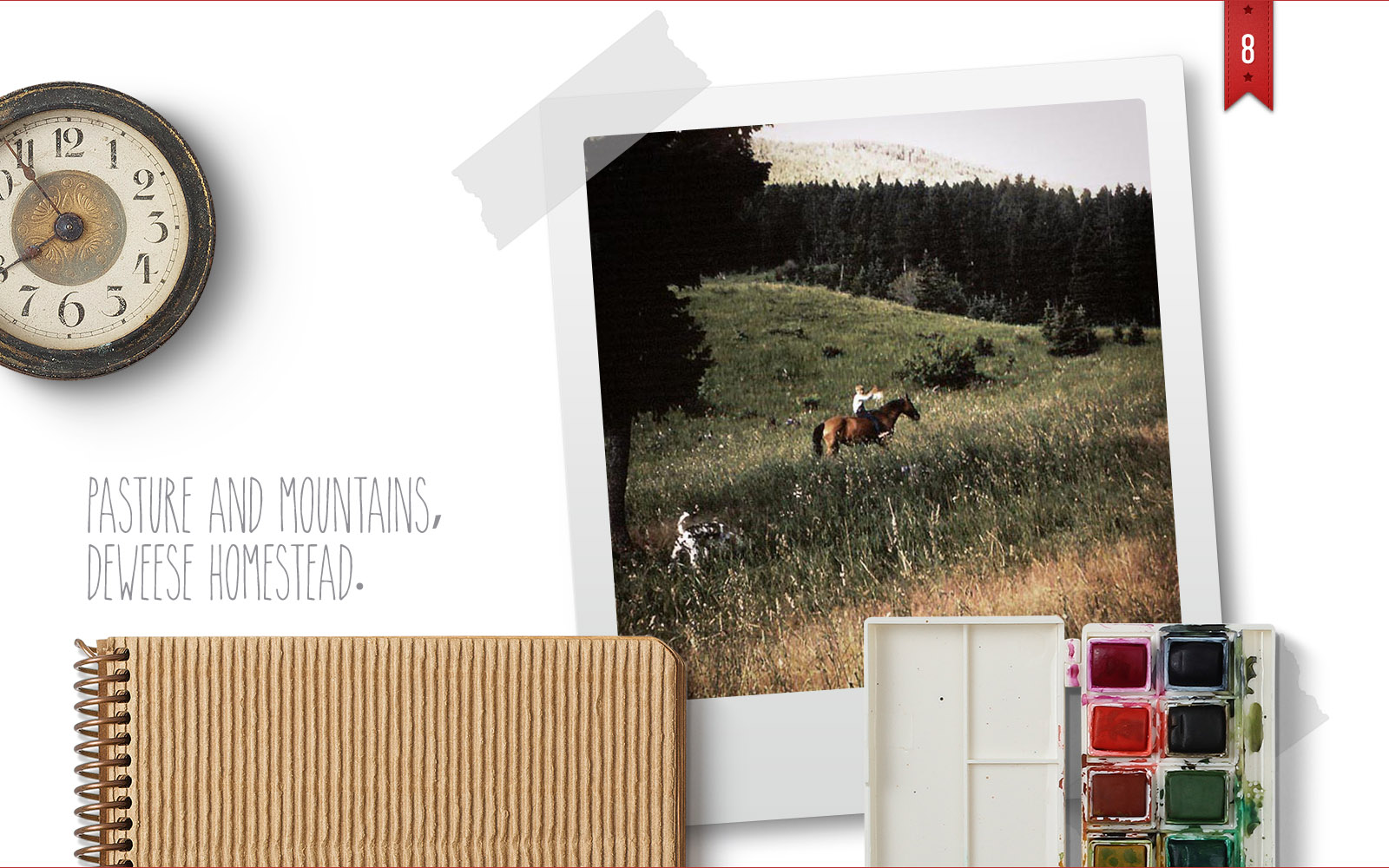
John explains that it’s been just great, something he and Sylvia have needed for years. … Sylvia seconds this. “Just to be out in the open in all this space,” she says. … “Lots of space in Montana,” DeWeese says, a little wistfully. He and John and the art instructor become involved in get-acquainted talk about differences between Montana and Minnesota. … The horse grazes peacefully below us, and just beyond it the water sparkles in the creek.
DeWeese Homestead, Gallatin Gateway, Montana. Chris on horseback. According to Gennie DeWeese, the horse was named Moccasin. The pasture lay across the road from their house, beyond Cottonwood Creek. It is now occupied by trees and a private residence.
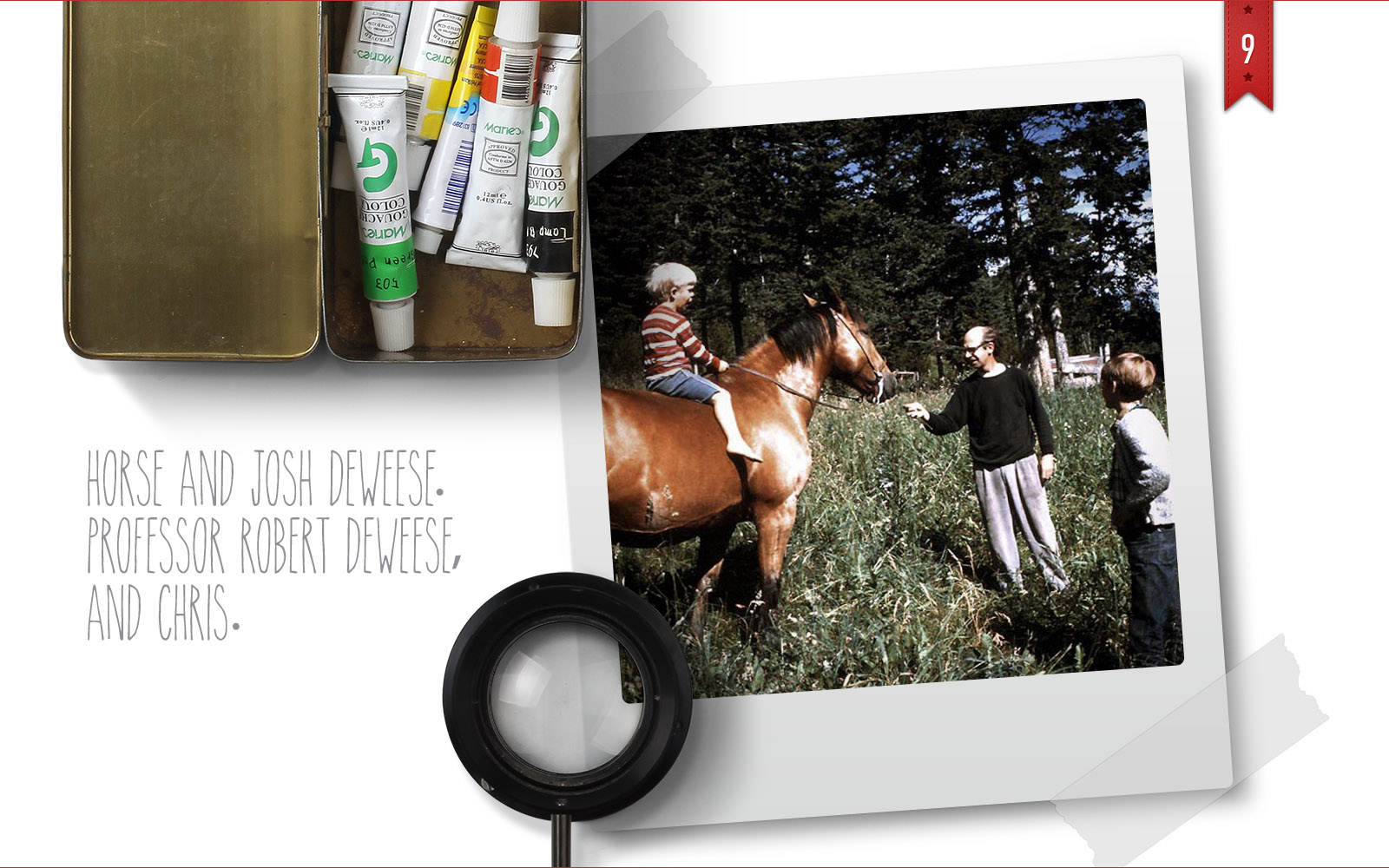
The talk has shifted to DeWeese’s land here in the canyon, how long DeWeese has lived here and what art instruction at the college is like. John has a real gift for casual conversation like this that I’ve never had, so I just listen. … I don’t know how much later I hear some comments about “the movie star here” come from John and I realize he is talking about me and my sunglasses.
DeWeese Homestead, Gallatin Gateway, Montana. Josh, the DeWeeses’ youngest son, sits on the horse. Robert DeWeese and Chris stand beside him.
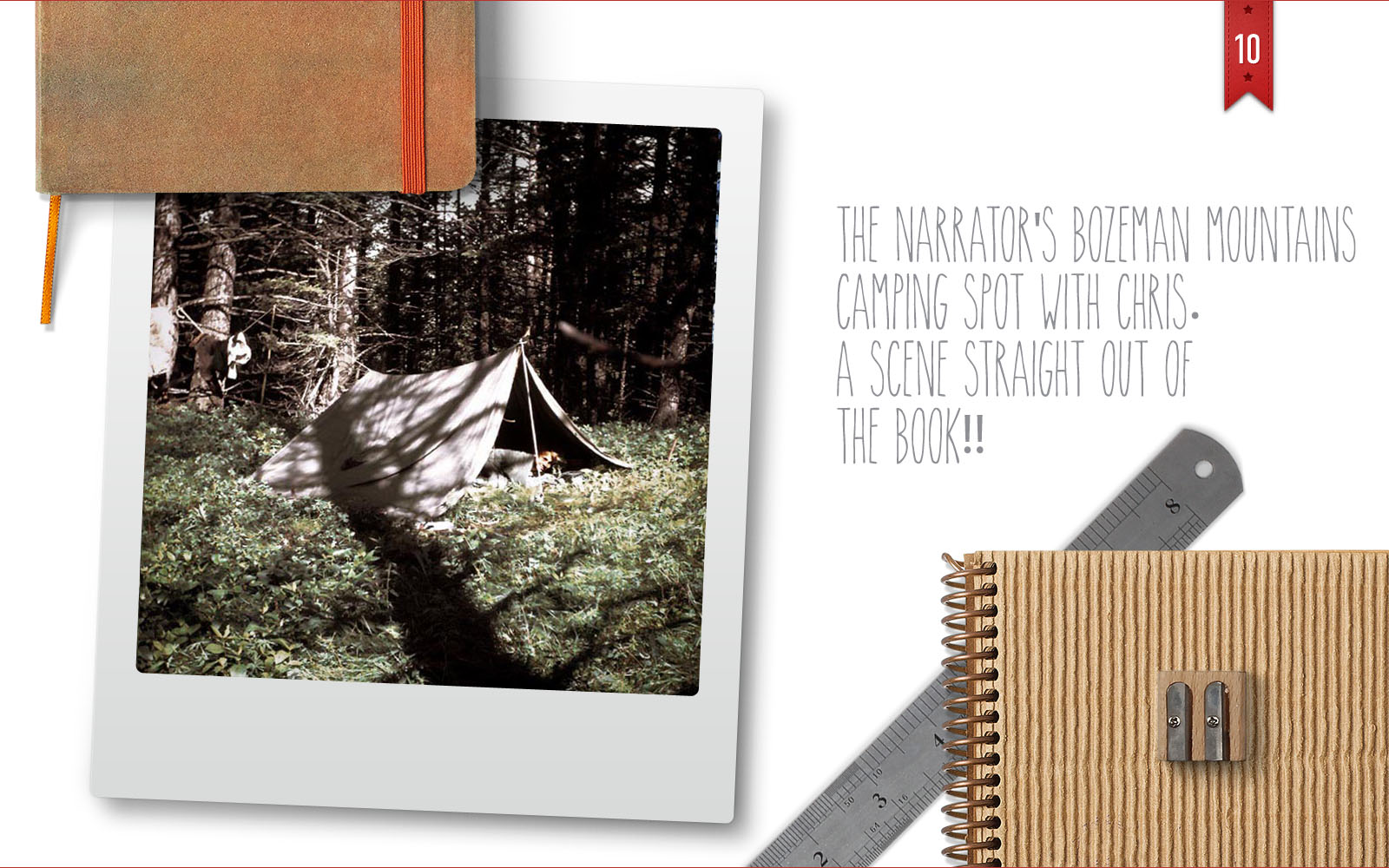
We come to a flat spot, a large knoll protruding from the side of the mountain. I tell Chris this is it for today. He seems satisfied and cheerful; maybe some progress has been made with him after all.
Chris in Cottonwood Canyon. The scene is described in Chapter 19.
Later I return to the tent where a noise indicates that Chris is awake, and when I look inside I see his face stare around silently. He’s a slow waker and it’ll be five minutes before his mind warms up to the point where he can speak. Now he squints into the light.
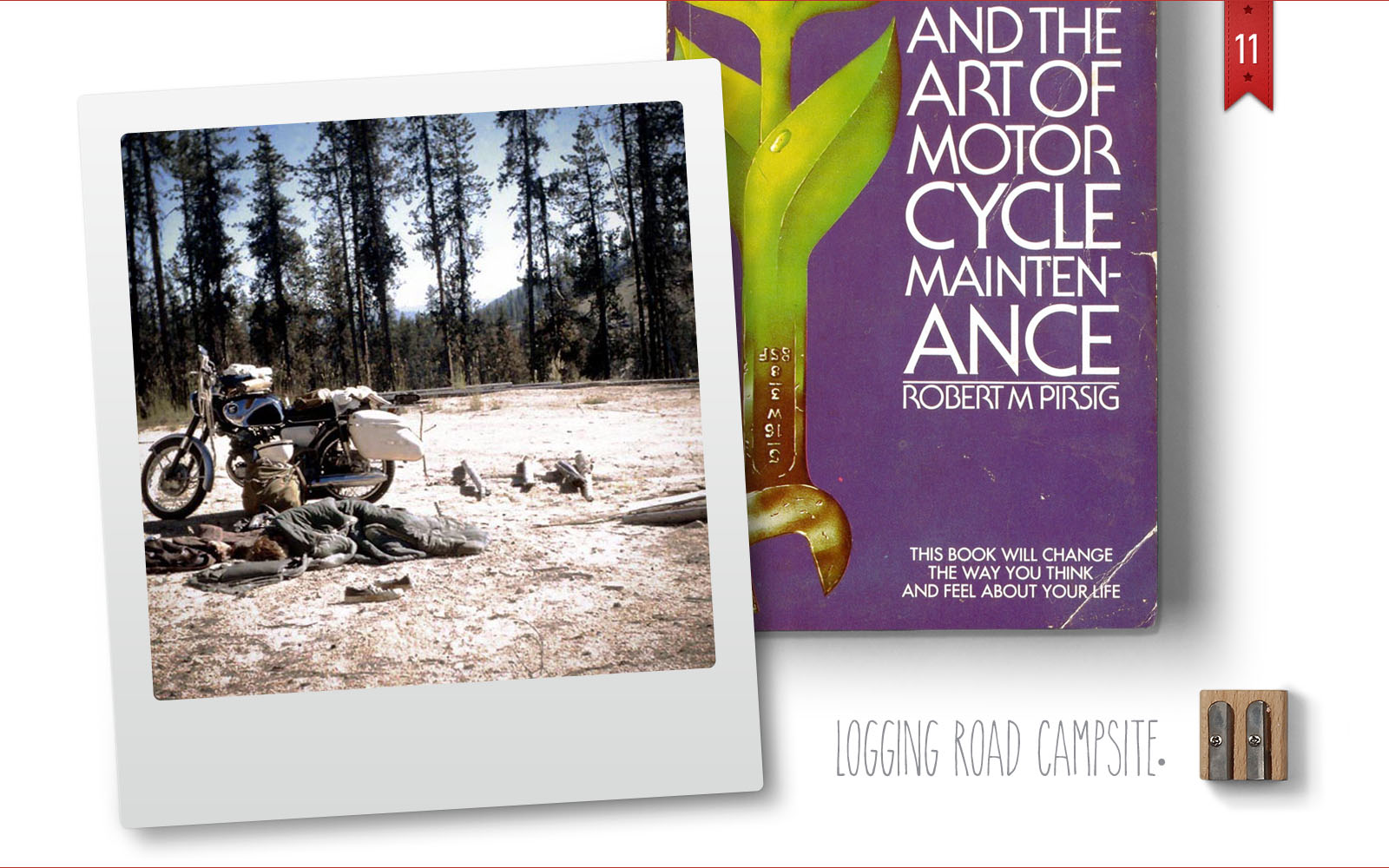
The logging road is sandy, so I keep in low gear with feet out to prevent a spill. We see side roads off the main logging road but I stay on the main one until after about a mile we come to some bulldozers. That means they’re still logging here. We turn back and head up one of the side roads. After about half a mile we come to a tree fallen across the road. That’s good. That means this road has been abandoned.
Idaho forest road. The scene appears at the beginning of Chapter 24. Chris is lying in the sleeping bag. In the motorcycle’s shiny fuel tank, you can make out the tiny reflection of the person taking the photograph.
I get out of the sleeping bag. It’s cold and I get dressed quickly. Chris is asleep. I walk around him, climb over a fallen tree trunk and walk up the logging road. To warm myself I speed up to a jog and move up the road briskly.
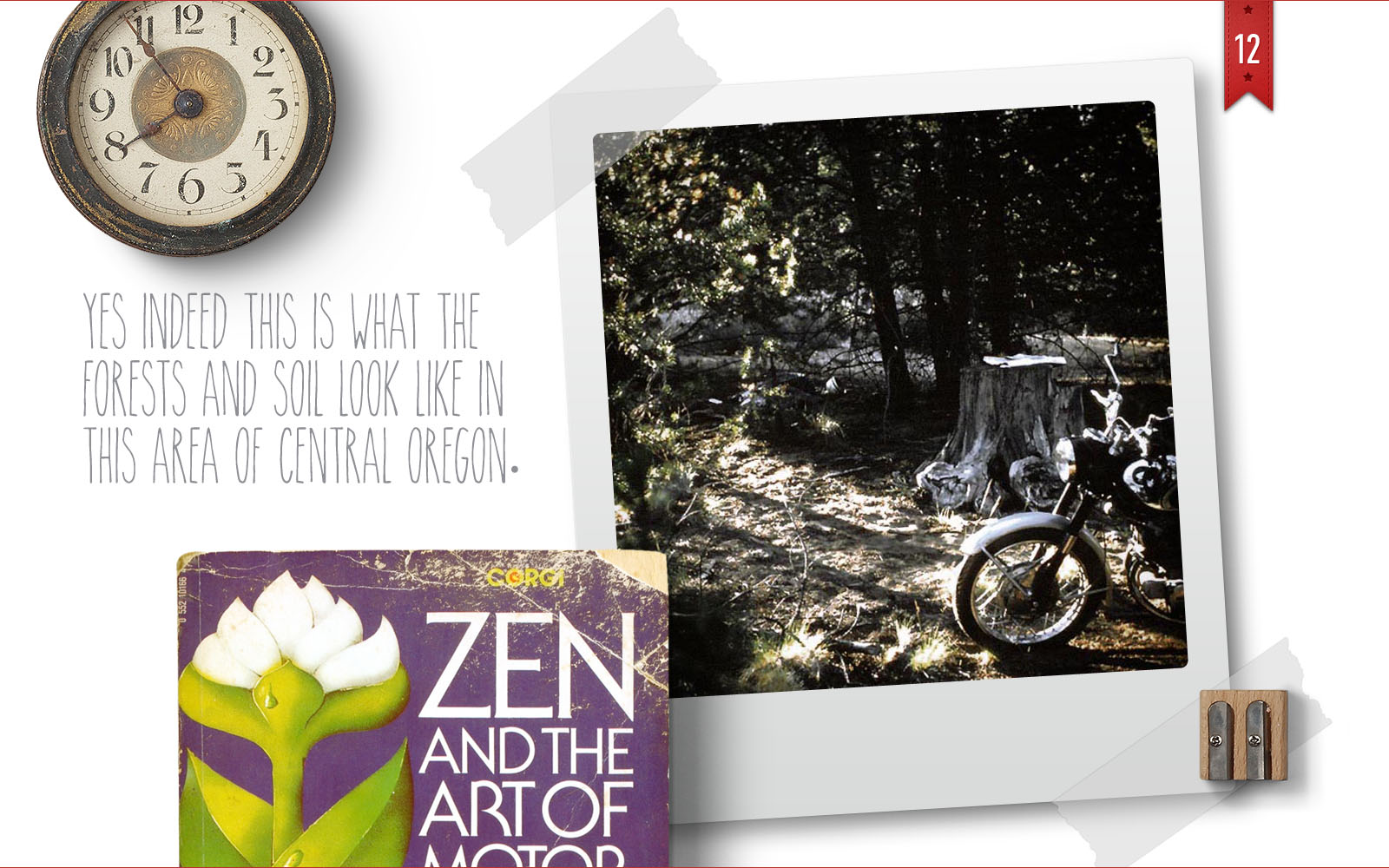
Farther south we find a forest of scrubby trees, subdivided into ridiculous little lots. Some developer’s scheme apparently. At one of the lots far off the main highway we spread out our sleeping bags and discover that the pine needles just barely cover what must be many feet of soft spongy dust. I’ve never seen anything like it. We have to be careful not to kick up the needles or the dust flies up over everything.
Just north of La Pine, Oregon. The scene appears in Chapter 28. In the background you can see a white helmet and, beside it, a sleeping bag with Chris inside.
Cold out! Feels like winter! Where are we, that it should get this cold? We must be at a high altitude. I look out of the sleeping bag and this time see frost on the motorcycle. On the chrome of the gas tank it’s sparkling in the early sunlight. On the black frame where the sunlight hits it it’s partly turned to beads of water that will soon run down to the wheel. It’s too cold to lie around. I remember the dust under the pine needles and put my boots on carefully to avoid stirring it up.